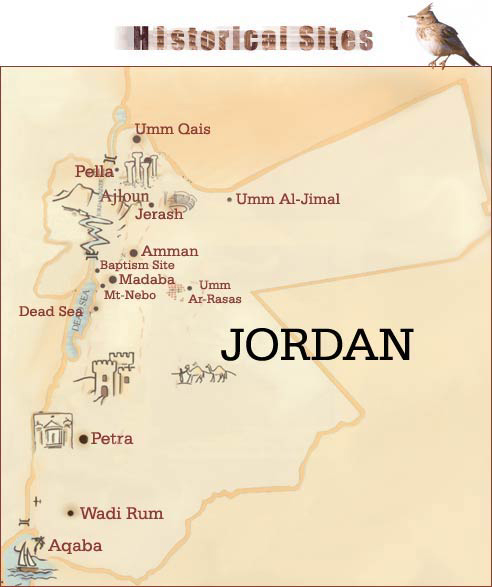
|
|
|
|
|
Visit this Greco-Roman town, also mentioned in the Bible, snugly located in a hillside of northern Jordan, and marvel at the sweeping view of Lake Tiberias and the Golan Heights from atop this Decapolis. Kindle that transcendental feeling, as you walk through the path of ancient flourishing civilizations, their remnants telling the story of the many travellers who entered its ancient gates; from the Macedonians, who first established their acropolis, to the Romans, Byzantines, Umayyads and Ottomans.
Umm Qais (Gadara)
Situated on a broad promontory 378 meters above sea level, this town was known as Gadara, one of the ancient Greco-Roman cities of the Decapolis, and according to the Bible, the spot where Jesus cast out the Devil from two demoniacs (mad men) into a herd of pigs (Mathew 8:28-34). In ancient times, Gadara was strategically situated, laced by a number of key trading routes connecting Syria and Palestine. It was blessed with fertile soil and abundant rainwater. This town also flourished intellectually and became distinguished for its cosmopolitan atmosphere, attracting writers, artists, philosophers and poets, the likes of Satirist Menippos (second half of the 3rd century BC), the epigrammist, Meleagros (ca.110-40 BC), and the rhetorician, Theodoros (AD14-37). Gadara was also the resort of choice for Romans vacationing in the nearby Himmet Gader Springs. one of the ancient Greco-Roman cities of the Decapolis, and according to the Bible, the spot where Jesus cast out the Devil from two demoniacs (mad men) into a herd of pigs (Mathew 8:28-34). In ancient times, Gadara was strategically situated, laced by a number of key trading routes connecting Syria and Palestine. It was blessed with fertile soil and abundant rainwater. This town also flourished intellectually and became distinguished for its cosmopolitan atmosphere, attracting writers, artists, philosophers and poets, the likes of Satirist Menippos (second half of the 3rd century BC), the epigrammist, Meleagros (ca.110-40 BC), and the rhetorician, Theodoros (AD14-37). Gadara was also the resort of choice for Romans vacationing in the nearby Himmet Gader Springs.
 Archaeological surveys indicate that Gadara was occupied as early as the 7th century BC. The Greek historian, Polybius, described the region as being under Ptolemic control at the time. The Seleucid ruler Antiochus III conquered it in 218 BC, naming the city Antiochia and Seleucia. In 63 BC, Pompey liberated Gadara and joined it to the Roman league of ten cities, the Decapolis. Soon after, the fortunes of Gadara improved rapidly and building was undertaken on a large scale, carried out for the love of Pompey's freed man, Demetrius, who had been born there. Archaeological surveys indicate that Gadara was occupied as early as the 7th century BC. The Greek historian, Polybius, described the region as being under Ptolemic control at the time. The Seleucid ruler Antiochus III conquered it in 218 BC, naming the city Antiochia and Seleucia. In 63 BC, Pompey liberated Gadara and joined it to the Roman league of ten cities, the Decapolis. Soon after, the fortunes of Gadara improved rapidly and building was undertaken on a large scale, carried out for the love of Pompey's freed man, Demetrius, who had been born there.
 During these early years of Roman rule, the Nabateans (with their capital in Petra) controlled the trade routes as far north as Damascus. Unhappy with the competition, Mark Anthony dispatched King Herod the Great to weaken the Nabateans, who finally gave up their northern interest in 31 BC. In appreciation for his efforts, Rome rewarded Herod with Gadara. During these early years of Roman rule, the Nabateans (with their capital in Petra) controlled the trade routes as far north as Damascus. Unhappy with the competition, Mark Anthony dispatched King Herod the Great to weaken the Nabateans, who finally gave up their northern interest in 31 BC. In appreciation for his efforts, Rome rewarded Herod with Gadara.
 The city reached its peak of prosperity in 2nd century AD and new colonnaded streets, temples, theatres and baths sprouted. Meleagros compared Gadara with Athens, which testifies to the city's status as a creative centre of Hellenism in the ancient Near East. The city reached its peak of prosperity in 2nd century AD and new colonnaded streets, temples, theatres and baths sprouted. Meleagros compared Gadara with Athens, which testifies to the city's status as a creative centre of Hellenism in the ancient Near East.
Christianity spread slowly among the inhabitants of Gadara. Starting from the 4th Century, its bishop attended the ecclesiastical councils of Nicaea, Chaleedon, and Ephesos. Despite his attendance, the city was no longer a seat of learning. During the 6th century, decline set in, and in AD 636 a decisive military clash between Byzantines and Arab Muslims took place not far from Gadara. However, there is no evidence of widespread destruction in the city.
Umm Qais's charm still lingers today. A large portion of the Western Roman Theatre, has survived history's upheavals. Vaulted passageway support its rows of seats, built of hard basalt stones. A row of elaborately carved seats for dignitaries stand near the orchestra, and in the centre was a large headless marble statue of Tyche, now displayed at the local museum.
 A cross from the theatre is the colonnaded street [cardo], which was in all likelihood the town's commercial centre. Also, near the black basalt theatre is the Terrace , which hosts an atrium [courtyard], a church and a basilica. Further west of the Terrace and along the east-west Colonnaded Street [decumanus], ruins of the Nymphaeum, a bath complex and a well-preserved Roman Mausoleum can be seen. After a few hundred meters one can barely make out the remains of what once was a Hippodrome. A cross from the theatre is the colonnaded street [cardo], which was in all likelihood the town's commercial centre. Also, near the black basalt theatre is the Terrace , which hosts an atrium [courtyard], a church and a basilica. Further west of the Terrace and along the east-west Colonnaded Street [decumanus], ruins of the Nymphaeum, a bath complex and a well-preserved Roman Mausoleum can be seen. After a few hundred meters one can barely make out the remains of what once was a Hippodrome.
Theaters
T here are two theatres in Gadara, and a third one located at the hot springs of Himmet Gader. Remains of the North Theatre, the largest one, are still visible in the hillside (next to the museum); the well-preserved West Theatre is the most graceful feature of Gadara. Built of black basalt stones, this theatre dates back to the first and the second centuries AD. You can enjoy a particularly spectacular view around sunset from the upper rows of the seats.
Vaulted Shops
The terrace is supported by vaulted structures, used as shops during the Roman times. These shops were slightly lower than the level of the Terrace. The road was paved and a Roman sidewalk existed in this area.
Nymphaeum
The Nympheaum, a fountain with basins and niches, usually decorated with marble statuettes, is located on the Decumanus, near the intersection of the two main colonnaded streets [cardo and decumanus] and across the Terrace. This sacred monument is believed to have been dedicated to the ancient water goddesses.
Roman Baths Complex
 Ruins of a Bath Complex, dating from the 4th century, can be seen by merging left into a small dirt road some 100 meters from the intersection of the Colonnaded Streets. You can also access its lower parts from a dirt road across from the West Theatre. Just as typical Roman baths, it had hot, warm, and cold rooms, as well as a room for disrobing. It apparently went out of use in the early 7th century . Ruins of a Bath Complex, dating from the 4th century, can be seen by merging left into a small dirt road some 100 meters from the intersection of the Colonnaded Streets. You can also access its lower parts from a dirt road across from the West Theatre. Just as typical Roman baths, it had hot, warm, and cold rooms, as well as a room for disrobing. It apparently went out of use in the early 7th century .
Tombs
A pproximately 500 meters from the Roman Baths you will find a well-preserved underground Roman Mausoleum [West Mausoleum]. Behind the black basalt stone cistern [underground water reservoir], steps lead to the entrance hall, which is the porch of the mausoleum itself. A five-aisled Basilica Church was recently excavated above the mausoleum. You can also find rock carved tombs scattered around the outskirts of Gadara, such as the tombs of Germani, Modestus and Chaireas.
The Western Gate\Gate of Tiberias
 S ome 800 meters from the point where the two main colonnaded streets intersect, or 200 meters from the Mausoleum, you will find the remains of the Western City Gate, consisting only of the foundations. The gate was flanked by circular towers, which straddled the Decumanus. Another 400 meters from the Western Gate there are the remains of a Triple Arched Gateway, which marked the extension of the city's boundary in the latter half of the 2nd century. S ome 800 meters from the point where the two main colonnaded streets intersect, or 200 meters from the Mausoleum, you will find the remains of the Western City Gate, consisting only of the foundations. The gate was flanked by circular towers, which straddled the Decumanus. Another 400 meters from the Western Gate there are the remains of a Triple Arched Gateway, which marked the extension of the city's boundary in the latter half of the 2nd century.
The Terrace
N ext to the West Theatre is the paved and colonnaded Terrace. Some of the structures that remain on the terrace include the colonnaded atrium, which served as the courtyard for the church, a large colonnaded octagon pertaining to the Centralized Church and an apse, remnants of a three-aisled Basilica located between the Centralized Church and the West Roman Theatre. To the west, the Terrace is supported by vaulted structures.
Centralized Church
This church is located on the Terrace and dates to the Byzantine period. The complex consists of a plaza and colonnade. A central octagon of columns capped with Corinthian capitals taken from a temple preceding the church, supported the roof of the Centralized Church.
Living Quarters

A classical Acropolis lies to the east of the West Theatre. Today it is covered by Bait Melkawi and the remains of the Ottoman village, built from stones taken largely from ancient buildings. One of the more substantial buildings was restored and converted into a museum, while another was rebuilt as a rest-house.
M useum of Umm Qais
 Located in Beit Al-Russan (House of Al-Russan), the Museum was originally the Ottoman governor's house. Statues, mosaics, coins, among other archaeological finds, are on display. Opening hours of the museum are: Everyday from 8:00-18:00 in summer and 8:00-17:00 in winter. For more information contact the museum: 00 962 2 7500071 Located in Beit Al-Russan (House of Al-Russan), the Museum was originally the Ottoman governor's house. Statues, mosaics, coins, among other archaeological finds, are on display. Opening hours of the museum are: Everyday from 8:00-18:00 in summer and 8:00-17:00 in winter. For more information contact the museum: 00 962 2 7500071

Umm Qais Rest-house
The Rest-house offers a relaxing retreat overlooking Lake Tiberias (Sea of Galilee). You may enjoy a view from indoors or outdoors, on the large open terrace. For more information contact the Rest-house : 00 962 2 7500555
Getting there:
By car or taxi : (from Amman) Umm Qais can be reached within two hours. Take either the Jordan Valley road towards the north or the scenic highland route towards Jerash and through Irbid. Follow the brown signs all the way to Umm Qais. | |
|

|
|
|
|
|
The marvels of nature and the genius of medieval Arab military architecture have  given north Jordan two of the most important ecological and historical attractions in the Middle East the sprawling pine forests of the Ajloun-Dibbine area, and the towering Arab-Islamic castle at Ajloun that helped to defeat the Crusaders eight centuries ago. Both these natural and man-made marvels, along with other attractions in the north, are being carefully protected to form the core of a pioneering Eco-tourism project now being implemented with French technical assistance, which aims to preserve the large pine forest that stretches from Ajloun towards the north; this is a unique environmental resource, for it is the southernmost complete pine forest in the world. given north Jordan two of the most important ecological and historical attractions in the Middle East the sprawling pine forests of the Ajloun-Dibbine area, and the towering Arab-Islamic castle at Ajloun that helped to defeat the Crusaders eight centuries ago. Both these natural and man-made marvels, along with other attractions in the north, are being carefully protected to form the core of a pioneering Eco-tourism project now being implemented with French technical assistance, which aims to preserve the large pine forest that stretches from Ajloun towards the north; this is a unique environmental resource, for it is the southernmost complete pine forest in the world.
The area's cool forests, beautiful picnic areas, and extensive walking trails already attract visitors throughout the April-October season, especially from the Gulf and other warmer regions of the Middle East.
The project that has been recently launched will designate three concentric zones:
a) an inner, fully protected nature reserve where the pine forest can flourish in perpetuity;
b) an environment-friendly Eco-tourism zone where private sector investments will be encouraged in services such as chalets;
c) a surrounding national park acting as a buffer zone, where visitors can enjoy picnics, trail walks, and other low-impact activities.
The combination of the invigorating forests, clean air, cool summer temperatures, easy access from all north Jordan, and a series of major antiquities sites promises to make this a leading new tourism destination, for both international and domestic tourists. The gateway to the national park will be from the Jerash region, just 20 minutes by car to the east. The Greco-Roman city of Jerash, among the best preserved cities of its kind in the world, is one of Jordan's leading tourist attraction.
Ajloun Castle, more formally known as Qalaat er-Rabad, is the major ancient site within the Ajloun forests region. It towers above the green hills and can be seen from many miles away, betraying its strategic purpose as a military watch post that protected the trade routes in the 12th –15th Centuries. It was first built in 1184 by the nephew of Salaheddin (Saladin), Izzeddin Usama Munqith, to repel the Crusader threats to north Jordan (the Crusaders had already occupied south Jordan, from their massive castles at Shobak and Karak, and were driven out of TransJordan in 1189).
T he Ajloun castle was expanded in 1214 into its current configuration. The castle is one of the best preserved and most complete examples of medieval Arab-Islamic military architecture. Among its main features are a surrounding dry moat, a drawbridge into the main entrance, the fortified entrance gate (with decorative pigeon stone carvings), a massive south tower, and several other towers on all sides. Inside, the castle is a labyrinth of vaulted passages, winding staircases, long ramps, enormous rooms that served as dining halls, dormitories, and stables, a total of 11 water cisterns, and the private quarters of the Lord of the Castle (complete with a small stone bathtub and rectangular windows that convert into arrow-slits for defensive purposes). Arab-Islamic military architecture. Among its main features are a surrounding dry moat, a drawbridge into the main entrance, the fortified entrance gate (with decorative pigeon stone carvings), a massive south tower, and several other towers on all sides. Inside, the castle is a labyrinth of vaulted passages, winding staircases, long ramps, enormous rooms that served as dining halls, dormitories, and stables, a total of 11 water cisterns, and the private quarters of the Lord of the Castle (complete with a small stone bathtub and rectangular windows that convert into arrow-slits for defensive purposes).
From the top of the castle, visitors enjoy panoramic views into the Jordan Valley and throughout the highlands of north Jordan. Excavations have recently identified a church that was built on the castle site in the earlier Byzantine period, while restoration and conservation works have made all areas of the castle accessible and safe for visitors. New restaurants and hotels in the immediate vicinity of the castle make it easier for visitors to spend an entire day, or a weekend, in this enchanting region. Other nearby sites that can be visited include the birthplace of the Prophet Elijah at nearby Listib, the Church of St Elijah at Khirbet Mar Elias, and scores of smaller ancient sites, including water mills, forts, and villages, in the hills and valleys of north Jordan.
| |
|
|
Screen Shot: Project BOB
|
|

 A close second to Petra on the list of favourite destinations in Jordan, the ancient city of Jerash boasts as unbroken chain of human occupation dating back more than 6,500 years. A close second to Petra on the list of favourite destinations in Jordan, the ancient city of Jerash boasts as unbroken chain of human occupation dating back more than 6,500 years.
The city's golden age came under Roman rule and the site is now generally acknowledged to be one of the best preserved Roman provincial towns in the world. Hidden for centuries in sand before being excavated and restored over the past 70 years, Jerash reveals a fine example of the grand, formal provincial Roman urbanism that is found throughout the Middle East, comprising paved and colonnaded streets, soaring hilltop temples, handsome theatres, spacious public squares and plazas, baths, fountains and city walls pierced by towers and gates.
 Beneath its external Graeco - Roman veneer, Jerash also preserves a subtle blend of east and west. Its architecture, religion and languages reflect a process by which two powerful cultures meshed and coexisted, The Graeco - Roman world of the Mediterranean basin and the ancient traditions of the Arab Orient. Beneath its external Graeco - Roman veneer, Jerash also preserves a subtle blend of east and west. Its architecture, religion and languages reflect a process by which two powerful cultures meshed and coexisted, The Graeco - Roman world of the Mediterranean basin and the ancient traditions of the Arab Orient.
 The Jerash festival, held in July every year, transforms the ancient city into one of the world's liveliest and most spectacular culture events. The festival features folklore dances by local and international groups, ballet, concerts, plays, opera, popular singers and sales of traditional handicrafts, all in the brilliantly floodlit dramatic surroundings of the Jerash ruins. The Jerash festival, held in July every year, transforms the ancient city into one of the world's liveliest and most spectacular culture events. The festival features folklore dances by local and international groups, ballet, concerts, plays, opera, popular singers and sales of traditional handicrafts, all in the brilliantly floodlit dramatic surroundings of the Jerash ruins.
| 
|
|
|
|
|
|
|
 Hidden behind an almost impenetrable barrier of rugged mountains, the rock-carved city of Petra is full of mysterious charm. The approach through the cool gloom of the Siq, a long narrow gorge whose steeply rising sides all but obliterate the sun, provides a dramatic contrast with the magic to come. Suddenly the gorge opens into a natural square dominated by Petra's most famous monument, the Khasneh, whose intricately carved facade glows in the dazzling sun. Hidden behind an almost impenetrable barrier of rugged mountains, the rock-carved city of Petra is full of mysterious charm. The approach through the cool gloom of the Siq, a long narrow gorge whose steeply rising sides all but obliterate the sun, provides a dramatic contrast with the magic to come. Suddenly the gorge opens into a natural square dominated by Petra's most famous monument, the Khasneh, whose intricately carved facade glows in the dazzling sun.
 More facades beckon the visitor on until the ancient city gradually unfolds, one monument leading to the next for kilometer after kilometer. The sheer size of the city and the quality of beautifully carved facades is staggering and leads one to reflect on the creativity and industry of the Nabateans who made Petra their capital more than 2,000 years ago. From their capital at Petra the Nabateans had established an elaborate network of caravan routes which brought spices, incense, myrrh, gold, silver and precious stones from India and Arabia, to be traded onto the west. More facades beckon the visitor on until the ancient city gradually unfolds, one monument leading to the next for kilometer after kilometer. The sheer size of the city and the quality of beautifully carved facades is staggering and leads one to reflect on the creativity and industry of the Nabateans who made Petra their capital more than 2,000 years ago. From their capital at Petra the Nabateans had established an elaborate network of caravan routes which brought spices, incense, myrrh, gold, silver and precious stones from India and Arabia, to be traded onto the west.
 From the wealth they acquired, they adorned their city with palaces, temples and arches. Many that were freestanding have largely disappeared but many were carved into the rock i.e. the treasury, the monumental tombs and the high place of sacrifice. These still remain today in a condition of perfection so staggering that you feel you must have entered a time wrap. Petra is an enchanting place that captivates and excites the senses. Its overwhelming size, rich textures and stunning surroundings create an ambiance almost impossible to describe. From the wealth they acquired, they adorned their city with palaces, temples and arches. Many that were freestanding have largely disappeared but many were carved into the rock i.e. the treasury, the monumental tombs and the high place of sacrifice. These still remain today in a condition of perfection so staggering that you feel you must have entered a time wrap. Petra is an enchanting place that captivates and excites the senses. Its overwhelming size, rich textures and stunning surroundings create an ambiance almost impossible to describe.
As you set off from the City's entrance gate, at this stage the valley is quite wide and open. This section is the approach to the narrow gorge and is know as Bab Es-Siq, gateway of the Siq. The first monuments you pass are the curious Djinn Blocks, a cluster of three freestanding rock cubes just to the right of the track.
 Continuing along the path you come to the Obelisk Tomb, carved out of the cliff. At one point the passageway goes from a wide breach to a dark chasm not more than a few feet across. Suddenly in the space of a few footsteps, you get your first glimpse of Petra's most fabled achievement, El-Khazneh (the Treasury), which looms up in the brilliant sunshine, carved from the rock, defiled by man. Continuing along the path you come to the Obelisk Tomb, carved out of the cliff. At one point the passageway goes from a wide breach to a dark chasm not more than a few feet across. Suddenly in the space of a few footsteps, you get your first glimpse of Petra's most fabled achievement, El-Khazneh (the Treasury), which looms up in the brilliant sunshine, carved from the rock, defiled by man.
At the outer siq's widest point a gully runs abruptly off to the south. The path takes you to the high place: an ancient Nabatean sacrificial site with an Altar cut from the rock. For those who can stand the strenuous climb, the sweeping view of Petra is well worthwhile.

Past the altar the track continues leading to the garden Tridinium (the garden temple complex). There are two freestanding colonnades, in front of which are a remnants of a shrine. Continuing on, one passes dozens of wall niches, before arriving at the Roman Soldier's Tomb, and a further Triclinium.
Petra has dozens of sacred sites. On a windswept ridge high above the city, the Nabatean people extolled their gods at the High Place known as El-Madbah in Arabic. In an area known as the street of facades, many classical Nabatean ruins can be seen.
The Outer siq makes a sudden turn northwards and leads to the Roman Theatre which was built in typical Roman style. The substantial building Qasr El Bint Faroun (Palace of the Pharoa's daughter'), demonstrates that the Nabateans were capable of creating freestanding buildings.

Petra's second most spectacular construction after the treasury is El-Deir (The Monastery). For a feeling of Petra's immensity and the sheer power of the rock, the trip is essential.
Across from the Qasr El Bint a jumbo of steps lead up to Petra's Museum. The room housing the small collection is the most monumental exhibit of all. | |
|
|
Screen Shot: Project BOB
|
|
|
|
|
 Stunning in its natural beauty, Wadi Rum epitomizes the romance of the desert. With its "moonscape" of ancient valleys and towering sandstone mountains rising out of the sand, Wadi Rum is also home to several Bedouin tribes who live in scattered camps throughout the area. Climbers are especially attracted to Wadi Rum because of its sheer granite and sandstone cliffs, while hikers enjoy its vast empty spaces. Wadi Rum is probably best known because of its connection with the enigmatic British officer T.E. Lawrence, who was based here during the Great Arab Revolt of 1917-18. Much of David Lean's Lawrence of Arabia was filmed in Wadi Rum. Stunning in its natural beauty, Wadi Rum epitomizes the romance of the desert. With its "moonscape" of ancient valleys and towering sandstone mountains rising out of the sand, Wadi Rum is also home to several Bedouin tribes who live in scattered camps throughout the area. Climbers are especially attracted to Wadi Rum because of its sheer granite and sandstone cliffs, while hikers enjoy its vast empty spaces. Wadi Rum is probably best known because of its connection with the enigmatic British officer T.E. Lawrence, who was based here during the Great Arab Revolt of 1917-18. Much of David Lean's Lawrence of Arabia was filmed in Wadi Rum.
 The main route to Wadi Rum, and the small village of Rum, branches east off the Desert Highway about five kilometres south of Quweira and 25 kilometres north of Aqaba. From there the road extends about 35 kilometres through the desert to end at Rum. It is best to take your own vehicle to Rum, as public transportation to the village is very difficult. The village consists mainly of several hundred Bedouin inhabitants with their goat-hair tents and concrete houses, a school, a few shops and the headquarters of the famous Desert Patrol. The main route to Wadi Rum, and the small village of Rum, branches east off the Desert Highway about five kilometres south of Quweira and 25 kilometres north of Aqaba. From there the road extends about 35 kilometres through the desert to end at Rum. It is best to take your own vehicle to Rum, as public transportation to the village is very difficult. The village consists mainly of several hundred Bedouin inhabitants with their goat-hair tents and concrete houses, a school, a few shops and the headquarters of the famous Desert Patrol.
 There are several options available for exploring Wadi Rum. At the Government Rest House, located just inside the village, you can rent out a four-wheel-drive jeep with a Bedouin driver for short or longer day tours of the area. Also available are camels, which you can hire for short excursions or for the desert trip to Aqaba. The only accommodations in Rum are in the Government Rest House, where tents are available. There are several options available for exploring Wadi Rum. At the Government Rest House, located just inside the village, you can rent out a four-wheel-drive jeep with a Bedouin driver for short or longer day tours of the area. Also available are camels, which you can hire for short excursions or for the desert trip to Aqaba. The only accommodations in Rum are in the Government Rest House, where tents are available.
 For those with a bit more time and/or sense of adventure, the best way to see Wadi Rum is by hiking and camping in it. Indeed, the vast silence and grandeur of the landscape is best experienced on foot. All you need for hiking in Wadi Rum is plenty of water (at least 2-3 litres per day), some food, good shoes and a sleeping bag. Those with a four-wheel drive, a map and plenty of fuel can see more of the landscape, while saving their energy for spectacular hikes such as the Rock Bridge of Burdah, one of Wadi Rum’s most popular attractions. For those with a bit more time and/or sense of adventure, the best way to see Wadi Rum is by hiking and camping in it. Indeed, the vast silence and grandeur of the landscape is best experienced on foot. All you need for hiking in Wadi Rum is plenty of water (at least 2-3 litres per day), some food, good shoes and a sleeping bag. Those with a four-wheel drive, a map and plenty of fuel can see more of the landscape, while saving their energy for spectacular hikes such as the Rock Bridge of Burdah, one of Wadi Rum’s most popular attractions.
 True adventurers can test their skills and endurance by climbing Jordan's highest mountain, Jabal Rum. The climb is a gruelling and treacherous challenge which should only be attempted by those of stout heart and indomitable will. A guide is recommended for the ten-hour round trip to the summit, and arrangements should be made the previous day at the Government Rest House. True adventurers can test their skills and endurance by climbing Jordan's highest mountain, Jabal Rum. The climb is a gruelling and treacherous challenge which should only be attempted by those of stout heart and indomitable will. A guide is recommended for the ten-hour round trip to the summit, and arrangements should be made the previous day at the Government Rest House.
 Offroaders should exercise care in staying on the tracks to avoid plowing over desert vegetation. Don’t venture too far away from Rum, and remember to bring plenty of water. Highly recommended for adventure-seekers are Tony Howard's detailed Treks and Climbs in the Mountains of Wadi Rum & Petra or the less extensive Walks & Scrambles in Rum Offroaders should exercise care in staying on the tracks to avoid plowing over desert vegetation. Don’t venture too far away from Rum, and remember to bring plenty of water. Highly recommended for adventure-seekers are Tony Howard's detailed Treks and Climbs in the Mountains of Wadi Rum & Petra or the less extensive Walks & Scrambles in Rum
| |
|
|
|
|
|
|
HISTORY AND SITES 
Take time off from the sun and fun and learn about the resort’s history, which dates back to the fourth millennium BC. Tel al-Khalifeh, inside the Jordanian-Eilat border, was initially identified with the Eziongerber, mentioned in the Holy Scriptures, where King Solomon built a fleet that sailed to Ophir (Somalia) and returned with 420 talents of gold. But recent excavations indicate that the site was found after the 8th Century BC and served commercial and industrial purposes: for smelting copper and as a halting place for caravans. During the 1st Century BC, the Nabteans, who raised livestock and pirated merchants’ ships in the Red Sea, inhabited Ayla. During the same time, merchants from Ailana were found in South Arabia (Yemen) buying frankincense and myrrh. From 106 AD, rulers and civilizations came and went, starting from the Romans, to the Sultans and Islamic rule.

Just prior to Islam, the Ghassanid Phylarchs (a tribe from western Arabia) controlled Ayla on behalf of Byzantium, its bishop at Ayla attended the Council of Nicaea in North Carolina State University, located the Nabatean-Roman town of Ayla two kilometers from Tell Al-Khlifeh , in the circular area of modern Aqaba.
In one of the most exciting discoveries in recent times, archaeologists in Aqaba have unearthed what they believe to be the world’s oldest church, from the late 3rd Century AD. It is slightly older than the Church of the Holy Sepulchre in Jerusalem and the Church of Nativity in Bethlehem, both of which date back to the 4th Century. The church is found on a plot of land east of Istiklal Street (see map). It is now back-filled with earth for protection.
The walled city of Ayla was constructed during the early days of the Islamic era—a rare example of early Islamic urbanization policy. Its layout is marked by axial streets leading to four gates and intersecting in the middle, where a tetrapylon (four interconnection arches) was set up, thus recalling the plan of roman legionary camps. Unearthed in the mid-1980s by an America –Jordanian archaeological team are the remains of Ayla, located along the main water front road, near the hotel district.

Islamic Ayla benefited from the annual pilgrimage to Mecca and continued to prosper until the end of the 12th Century when the city suffered from a series of earthquakes, Bedouin raids, and Crusader attacks.
The Aqaba fort was rebuilt in 1587 AD under one of the last Mamluke Sultans and has been substantially altered several times since then. The Hashemite Coat of Arms was placed above the main doorway during the Great Arab Revolt of World War I, during which the Turks were driven out of the city. Running around the first bay of the passageway is a band of Arabic inscription. written in Nakshi character, which gives the name of the Mamluke Sultan, Qansweh Al-Ghuri (1501-1516 AD), responsible for building the fort
By the beginning of the 16th Century both Aqaba and the island had been ruled by the Ottoman Empire. The city declined in status and for about 400 years remained a simple fishing village of little significance. During World War I, Ottoman forces withdrew from the town after the Arab Army of Sharif Hussein bin Ali, the Hashemite Leader of the Great Arab Revolt, attacked them. T.E. Lawrence, popularly known as Lawrence of Arabia, took part in this campaign.
 CLIMATE CLIMATE
Surrounded by rugged purplish mountains, Aqaba enjoys formidable weather throughout the year. In the winter, while Amman shivers at 5 C, the temperature hovers steadily around 20 C. and while spring and fall are the best times to visit Aqaba, the fresh cool breeze coming in from the sea alleviates the summer’s temperatures, which could reach a high of 40 C.
Surrounded by rugged purplish mountains, Aqaba enjoys formidable weather throughout the year. In the winter, while Amman shivers at 5 C, the temperature hovers steadily around 20 C. and while spring and fall are the best times to visit Aqaba, the fresh cool breeze coming in from the sea alleviates the summer’s temperatures, which could reach a high of 40 C.
WATER SPORTS
 The tranquil waters of this port-resort make water sports enjoyable. Scuba diving, snorkelling, water skiing, windsurfing and fishing are just some of the popular activities in Aqaba. The Gulf of Aqaba is a world known diving area. Aqaba itself offers eager divers the chance to experience virgin coral reefs, rare marine life forms, and encounters with friendly sea animals like turtles and dolphins. The tranquil waters of this port-resort make water sports enjoyable. Scuba diving, snorkelling, water skiing, windsurfing and fishing are just some of the popular activities in Aqaba. The Gulf of Aqaba is a world known diving area. Aqaba itself offers eager divers the chance to experience virgin coral reefs, rare marine life forms, and encounters with friendly sea animals like turtles and dolphins.

MARINE LIFE
Some of the many exotic marine animals and coral reefs are nestled beneath the warm, crystal clear waters of the Red Sea. Sting and manta rays, clown, angel, butterfly and lionfish, and occasionally turtles, eels and dolphins are spotted amid the resort’s exquisite coral reefs. Over 140 species of coral and at least 40 species of fish and other invertebrates have been identified in Aqaba, creating a colourful kaleidoscope. This, combined with the Gulf’s depth and its isolation of sea currents, which minimize turbulence and improve visibility, make it one of the most rewarding scuba diving and snorkelling spots in the world.
TRANSPORTATION
 Transportation within Aqaba is easy. Taxis, rental cars and buses are easily accessible. From Aqaba, there are JETT and Alpha buses, public busses, and taxis to Amman and Wadi Rum. Royal Wings Airlines has daily flights between Aqaba and Amman. The 10km drive from the Jordanian-Israel border crossing to the city costs approximately three Jordanian Dinars. Taxis within the city are usually not metered. A minimum of half to one Jordanian Dinars is expected Transportation within Aqaba is easy. Taxis, rental cars and buses are easily accessible. From Aqaba, there are JETT and Alpha buses, public busses, and taxis to Amman and Wadi Rum. Royal Wings Airlines has daily flights between Aqaba and Amman. The 10km drive from the Jordanian-Israel border crossing to the city costs approximately three Jordanian Dinars. Taxis within the city are usually not metered. A minimum of half to one Jordanian Dinars is expected
|
|
|
|
|
|
|
|
|
The Dead Sea eastern coast in Jordan is one of the most spectacular natural and spiritual landscapes in the whole world. A series of new roads, hotels and archaeological discoveries are converging to make this region, the lowest spot on earth at 410 meters below sea level, as enticing to international visitors today as it was to kings, emperors, traders and prophets in antiquity.
The leading attraction at the Dead Sea is the hot, soothing super-salty seawater, which is four times saltier than normal seawater. It is rich in chloride salts of magnesium, sodium, potassium, bromine and several others. This unusually salty, buoyant and mineral-rich water has attracted visitors since ancient times, all of whom have floated effortlessly on their backs while soaking up the water’s healthy minerals along with the gently defused rays of the Jordanian sun.
|


|
|


|
The Dead Sea’s total attraction is due to its unique combination of several factors: the chemical composition of its water, the filtered sunrays and oxygen-rich air, the mineral-rich black mud along the shoreline, and the adjacent fresh water and thermal mineral springs.
The opening of the new 5-star Movenpick Hotel and Resort, combined with the existing 4-star Dead Sea Spa Hotel, allows visitors to stay in the valley while exploring its many attractions. | | |
|
|
|
|
|
|
 Close to the village of Faysaliyah seven kilometers west of Madaba, Mount Nebo rises from the Transjordanian plateau. It is bound on the east by the Wadi Afrit (which extends into the Wadi el-Kanisah) and the Wadi Judeideh further south and on the north by the Wadi en-Naml and further the Wadi Ayoun Mousa . It is flanked on the west by the Jordan Valley Close to the village of Faysaliyah seven kilometers west of Madaba, Mount Nebo rises from the Transjordanian plateau. It is bound on the east by the Wadi Afrit (which extends into the Wadi el-Kanisah) and the Wadi Judeideh further south and on the north by the Wadi en-Naml and further the Wadi Ayoun Mousa . It is flanked on the west by the Jordan Valley
 Mount Nebo's highest crest reaches an altitude of 800 meters above the surrounding Belqa plateau.. The other peaks are slightly lower, all of them rising from 700 meters. Of these, the two most important, historically speaking are the peaks of Siyagha (710m.) on the western side and the peak of el Mukhayyat (790m.) on the S-E. All the year round several streams flow down the sides of the mountain: Ayoun Mousa and Ain Jemmaleh on the north, Ain Judeideh, Kanisah and Ain Hery on the south. Mount Nebo's highest crest reaches an altitude of 800 meters above the surrounding Belqa plateau.. The other peaks are slightly lower, all of them rising from 700 meters. Of these, the two most important, historically speaking are the peaks of Siyagha (710m.) on the western side and the peak of el Mukhayyat (790m.) on the S-E. All the year round several streams flow down the sides of the mountain: Ayoun Mousa and Ain Jemmaleh on the north, Ain Judeideh, Kanisah and Ain Hery on the south.
 Nebo provides a unique natural balcony for a bird's-eye view of the Holy Land and southern Jordan. If the observer looks to the south, the panorama extends over the Dead Sea and the Desert of Judah. Looking to the west, it includes the Valley of the Jordan with the mountains of Judea and Samaria, and more to the north Jebel Osha and the southern slopes of the Wadi Zerqa. The hills around Amman are plainly visible to the observer in the distance, and on the steep limits of the plateau Hesban and the mountain of Mushaqar. Nebo provides a unique natural balcony for a bird's-eye view of the Holy Land and southern Jordan. If the observer looks to the south, the panorama extends over the Dead Sea and the Desert of Judah. Looking to the west, it includes the Valley of the Jordan with the mountains of Judea and Samaria, and more to the north Jebel Osha and the southern slopes of the Wadi Zerqa. The hills around Amman are plainly visible to the observer in the distance, and on the steep limits of the plateau Hesban and the mountain of Mushaqar.
On very clear days the unaided eye can pick out Bethlehem and not far from there the singular cone that was Herod's fortress of Herodium, the towers and buildings of Jerusalem from the Mount of Olives all the way to Ramallah. In the valley of the Jordan Qumran is easily discerned by the side of the Dead Sea, then the oasis of Jericho, Shunet Nimrin, the dams of the Wadi Shueib and the Wadi Kafrein, Tell er-Rameh-Livias, Tuleilat el Ghassul and Suweimeh. On the edge of the plateau near Jebel Osha on the hilly spurs of El Salt Iraq el-Amir is visible.
| |
|
|


